 ultimate-guide
How to Spot Quality Furniture Online: A 2026 Guide
Table of Contents
- Examine Construction Methods to Spot Quality Furniture Online
- Solid Wood vs Veneer Furniture: What Matters
- How to Check Furniture Joinery Through Online Photos
- Assess Upholstery Fabric Durability Ratings and Quality
- Verify Hardware, Finish Quality, and Weight Capacity
- Evaluate Seller Credibility and Warranty Protection
- Spot Red Flags in Shipping, Assembly, and Sustainability
- Conclusion
Last Updated: August 28, 2026
Examine Construction Methods to Spot Quality Furniture Online
Quality furniture is built on solid construction. When shopping online, manufacturers reveal these details through product descriptions and close-up photography. Learning to decode them transforms you from a passive browser into someone who can spot quality before purchasing.
The best furniture uses time-tested joinery techniques: dovetail joints, mortise and tenon connections, and corner blocking. These methods distribute stress evenly, preventing the wobbling and creaking that plague cheaper furniture within a year or two.
Dovetail and Mortise-and-Tenon Joints
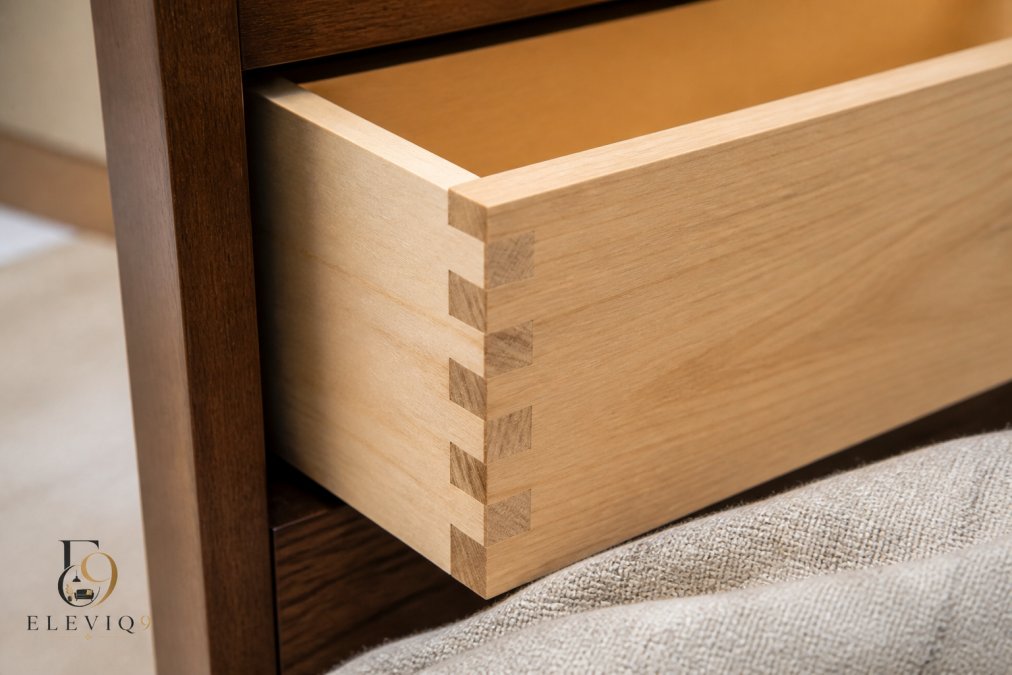
Dovetail joints are interlocking wooden joints shaped like interlocking fingers, most commonly found in drawer construction. Mortise and tenon joints involve a projecting piece (the tenon) that fits into a cavity (the mortise), creating a mechanically strong connection that relies on geometry rather than fasteners alone.
When examining product photos, look for these joints in drawer fronts and frame corners. Close-up images showing drawer connections are a green flag, manufacturers confident in their construction showcase these details. Dovetail construction withstands decades of drawer opening and closing, while stapled or glued butt joints fail much sooner under repeated stress (peer-reviewed research). When evaluating upholstered pieces, ask whether drawers use dovetail construction.
Corner Blocking and Frame Reinforcement
Corner blocking refers to triangular or rectangular wooden blocks glued and screwed into the inside corners of furniture frames. These invisible blocks are critical to structural integrity. A frame with corner blocking handles years of weight and movement; without it, the frame gradually racks (twists out of square), leading to wobbling and failure.
In product descriptions, look for mentions of "corner blocked" or "reinforced frame construction." Some sellers include interior photos showing the frame structure. If you see wooden blocks at the corners, that's a strong indicator of quality. If interior photos show a bare frame with no blocking, that furniture will likely wobble within two to three years.
Solid Wood vs Veneer Furniture: What Matters
The assumption that solid wood is always superior and veneer always inferior is misleading. Solid wood expands and contracts with humidity changes; in climates with significant seasonal swings, solid wood panels wider than about 12 inches will eventually crack or warp. Veneer, a thin layer of real wood glued to a plywood substrate, actually handles humidity better because the substrate is dimensionally stable.
The real quality question isn't solid versus veneer, it's whether the piece is made with care and appropriate materials for its function.
Identifying Solid Wood in Product Descriptions
Manufacturers use specific language when describing solid wood. Look for phrases like "solid hardwood frame," "kiln-dried hardwood," or specific wood types like "solid walnut" or "solid oak." Kiln-dried is important because it means the wood was dried in a controlled environment, reducing warping or cracking risk.
When a product description says "solid wood" without specifying the type, that's a yellow flag. The best pieces name the wood species. Engineered wood (plywood) consists of thin layers glued with alternating grain direction, creating a stable panel. Particleboard, made from wood chips and sawdust compressed with adhesive, has no place in quality furniture, it swells when wet, can't be repaired, and deteriorates over time.
When Veneer and Engineered Wood Are Legitimate Choices
A veneered top over plywood is actually the correct choice for large surfaces like dining tables or dresser tops. Solid wood panels that large will crack. Veneer solves this problem while allowing beautiful wood grain patterns.
Quality veneered furniture depends on veneer thickness and substrate quality. Thin veneer (less than 1/16 inch) can be sanded and refinished if damaged. Thick veneer (1/8 inch or more) is even better. The substrate should be plywood, not particleboard. Look for descriptions specifying veneer thickness and substrate type. A veneered piece with a plywood substrate, solid wood frame, and quality joinery will outlast a poorly constructed solid wood piece.
How to Check Furniture Joinery Through Online Photos
Product photography reveals far more than most shoppers realize. The angle, lighting, and detail level signal whether a manufacturer stands behind their construction.
What to Look for in Close-Up Images
Request close-up photos of joints, frame corners, and drawer construction. Look for:
- Tight, even gaps at joints (no visible daylight between pieces)
- Consistent wood grain and color
- Visible joinery techniques like dovetails or mortise and tenon connections
- Evidence of corner blocking inside frames
- Smooth, splinter-free edges on visible wood surfaces
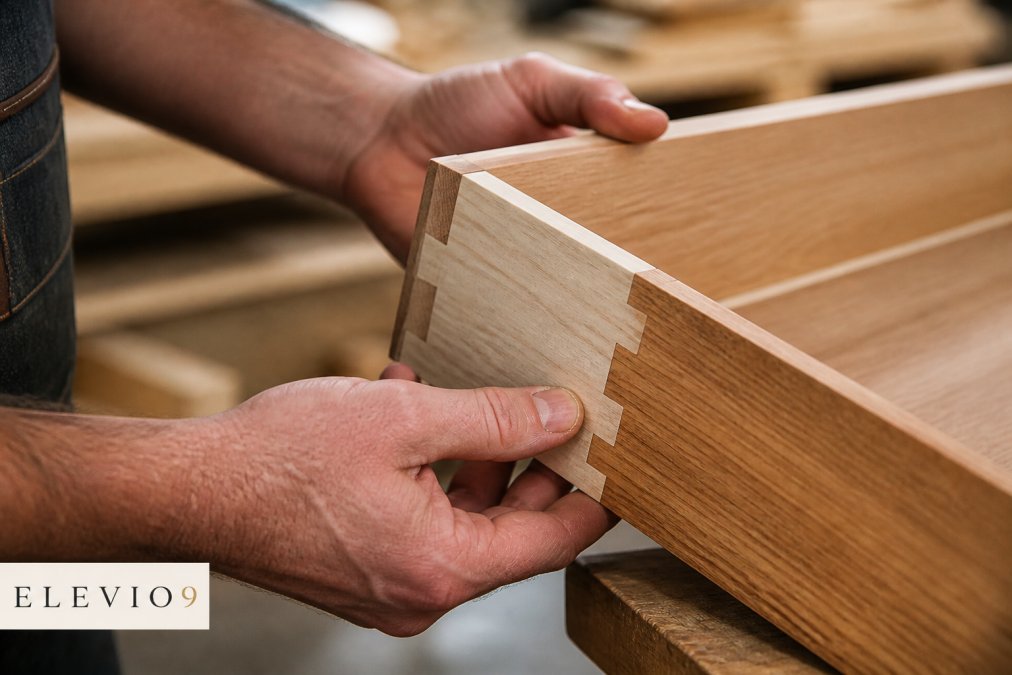
When examining drawer photos, pay attention to how the drawer front connects to the sides. Dovetail joints are unmistakable, you'll see the interlocking finger pattern. For upholstered pieces, close-ups should show consistent stitching patterns with even spacing. Hand-tied springs (often described as "eight-way hand-tied") are superior to sinuous wire springs or no springs at all.
Red Flags in Construction Photography
If product photos are always shot from a distance and never include close-ups of joints or construction details, the manufacturer may be hiding poor craftsmanship. Photos that are heavily filtered, shadowed, or shot at obscuring angles warrant skepticism.
Watch for inconsistency in wood grain or color across visible surfaces. If a drawer front shows dramatically different grain patterns than the frame, that suggests cost-cutting elsewhere in construction.
Assess Upholstery Fabric Durability Ratings and Quality
Fabric choice determines whether an upholstered piece will look fresh after five years or worn after two.
Understanding Rub Count and Fabric Performance Standards
Rub count measures how many times fabric can be rubbed with a standard testing tool before showing visible wear. The Martindale test is the industry standard. Fabric rated for 15,000 double rubs suits occasional use. Fabric rated for 50,000 double rubs handles regular family use. Commercial-grade fabric rated for 100,000 or more double rubs suits high-traffic environments (astm.org).
For a sofa or chair with regular use, look for fabric with at least 50,000 double rubs. If the product description doesn't mention rub count, ask the seller. Solution-dyed fabrics (where color is part of the fiber itself) resist fading and staining better than piece-dyed fabrics. Fabrics labeled "performance fabric" or "performance upholstery" are engineered to resist wear, fading, and staining.
Cushion Density, Spring Systems, and Resilience
Cushion density is measured in pounds per cubic foot. Density below 1.5 pounds per cubic foot will compress and flatten within a year or two. Density between 1.8 and 2.2 pounds per cubic foot is appropriate for most seating. Density above 2.5 pounds per cubic foot is premium and lasts significantly longer (peer-reviewed research).
The product description should specify cushion density. Eight-way hand-tied springs are the gold standard, with each spring individually tied to its neighbors, distributing weight evenly. Sinuous wire springs are less expensive but still durable. High-resiliency foam with no springs is acceptable for lighter use but won't perform as well over time.
Look for product descriptions mentioning "high-resiliency foam" or "HR foam," which bounces back more effectively than standard foam.
Verify Hardware, Finish Quality, and Weight Capacity
Hardware, hinges, drawer slides, handles, and fasteners, determines whether a piece functions smoothly for years or becomes frustrating within months.
Hinges, Drawer Slides, and Assembly Hardware
Full-extension drawer slides allow the drawer to pull out completely without tipping. Partial-extension slides only pull out partway. Full-extension is superior for accessibility and safety. Look for product descriptions specifying "full-extension slides."
Metal slides are more durable than plastic. Ball-bearing slides operate more smoothly and last longer than friction slides. For cabinets, soft-close hinges prevent doors from slamming and indicate a higher-quality piece. Stainless steel hardware resists corrosion better than plated steel.
Weight capacity is listed in product specifications and should match your intended use. It reflects both frame strength and the cushioning system's ability to support the load.
Finish Durability and Surface Treatment
Lacquer, polyurethane, and oil are common finishes. Lacquer and polyurethane provide protective layers resisting scratches and stains better than oil finishes. Product descriptions should specify the finish type. Look for mentions of "hand-applied finish" or "multi-coat finish," indicating more care than a single spray coat.
Evaluate Seller Credibility and Warranty Protection
Where you buy matters as much as what you buy. A quality piece from a disreputable seller with no warranty becomes a risk.
Reading Customer Reviews and Real-World Feedback
Customer reviews reveal what happens after purchase. Look for patterns rather than individual reviews. If multiple customers mention the same issue, wobbling, cushions compressing quickly, hardware failing, that's a genuine quality concern.
Pay attention to review dates. Recent reviews are more relevant. Look for reviews from customers who have owned the piece for at least six months to a year. Reviewers mentioning multiple years of satisfaction are particularly valuable. Check whether the seller allows verified purchase reviews, which means the reviewer actually bought the product.
Understanding Warranty Coverage and Return Policies
A warranty is a manufacturer's promise about durability and willingness to stand behind the piece. Read warranty terms carefully. Some cover structural defects but not cosmetic damage. The warranty length often correlates with expected durability.
Return policies matter for online purchases. A 30-day return policy gives time to inspect and return if needed. Longer return windows are better. Check whether returns are free or if you pay shipping. Look for sellers specifying how returns are handled and whether they refund the full purchase price or issue store credit.
Spot Red Flags in Shipping, Assembly, and Sustainability
The journey from warehouse to your home reveals potential quality issues.
Assembly Complexity and Hardware Concerns
Furniture requiring extensive assembly is more prone to problems than mostly assembled pieces. Complex assembly means more opportunities for mistakes. Pieces arriving fully assembled or requiring minimal assembly are generally higher quality.
Examine photos of included hardware. Cheap hardware, thin metal, plastic fasteners, poorly finished bolts, suggests overall cost-cutting. Quality pieces include substantial hardware clearly designed to last. Furniture shipped in a single box is more prone to damage than pieces in protective packaging. Look for descriptions mentioning foam corners, cardboard protection, and secure wrapping.
Eco-Certifications and Sustainable Material Sourcing
Look for certifications like FSC (Forest Stewardship Council) for wood, indicating responsible forest management. GREENGUARD certification indicates low chemical emissions, important for indoor air quality.
Product descriptions mentioning sustainable sourcing or eco-friendly practices suggest the manufacturer cares about environmental impact. This often correlates with overall quality because manufacturers committed to sustainability tend to prioritize durability, a piece lasting longer has less environmental impact than one needing frequent replacement.
Selecting quality furniture online requires moving beyond surface-level aesthetics to understand how pieces are actually built. The construction methods, material choices, and hardware specifications you've learned to identify are the same details professionals use when evaluating furniture. By applying these standards to your online shopping, you're equipped to invest in pieces enhancing your home for years to come. At Eleviq9, our curated collection of luxury home decor emphasizes these quality markers, from solid wood frames with corner blocking to high-performance upholstery fabrics with substantial rub counts. When you're ready to invest in furniture combining sophisticated design with lasting durability, our selection of modern bohemian pieces reflects the construction standards outlined here. Explore our collection and add timeless pieces to your home that you'll appreciate for decades.
=== FAQ ANSWERS (audit these too, same rules) ===
[1] Q: How can you tell if furniture is high-quality just by looking at online photos? A: Examine close-up images for construction details: look for dovetail or mortise-and-tenon joints in drawers, solid wood edges rather than thin veneers on visible surfaces, and tight stitching on upholstery. Check product descriptions for kiln-dried hardwood, eight-way hand-tied springs, and hardware specifications. Request additional photos of the back, underside, and joinery if the listing doesn't provide them. High-quality sellers provide multiple angles and detailed shots; mass-produced pieces often show only styled, front-facing photography.
[2] Q: What is the difference between solid wood and veneer in luxury furniture? A: Solid wood is actual timber throughout the piece, offering durability and the ability to refinish, making it ideal for heirloom-quality furniture. Veneer is a thin layer of real wood applied to engineered wood or plywood, which is lighter, more stable, and often used for large surfaces like tabletops to prevent warping. Luxury furniture uses veneer strategically on panels while reserving solid wood for structural frames and visible edges. Neither is inherently inferior; the quality depends on construction method, wood species, and how well the veneer is applied. Check product descriptions for 'kiln-dried hardwood frame' or 'solid wood construction' to identify which approach the maker used.
[3] Q: What materials and certifications indicate long-lasting furniture construction? A: Look for kiln-dried hardwood frames (reduces warping), eight-way hand-tied springs or high-density foam in upholstery, and full-extension drawer glides rated for repeated use. Fabric rub counts above 15,000 cycles indicate durability for high-traffic pieces. Certifications like FSC (Forest Stewardship Council) for sustainable wood sourcing and GREENGUARD for low chemical emissions signal responsible manufacturing. Manufacturers that publish weight capacity, warranty length, and testing standards demonstrate confidence in structural integrity. Check product pages for these specifications; vague descriptions like 'quality materials' are typical of mass-produced furniture.
[4] Q: What should I look for in upholstery and fabric quality online? A: Request the fabric rub count (higher than 15,000 is suitable for daily use) and fiber content from the seller. Natural fibers like linen and wool offer character but require care; performance fabrics resist stains and fading better. Examine close-up photos for tight, even stitching with no loose threads, and verify cushion density (measure in pounds per cubic foot if available). Ask about the spring system: eight-way hand-tied springs last longer than sinuous wire. Review customer photos and reviews specifically mentioning durability and how the fabric has held up over time.
Frequently Asked Questions
How can you tell if furniture is high-quality just by looking at online photos?
Examine close-up images for construction details: look for dovetail or mortise-and-tenon joints in drawers, solid wood edges rather than thin veneers on visible surfaces, and tight stitching on upholstery. Check product descriptions for kiln-dried hardwood, eight-way hand-tied springs, and hardware specifications. Request additional photos of the back, underside, and joinery if the listing doesn't provide them. High-quality sellers provide multiple angles and detailed shots; mass-produced pieces often show only styled, front-facing photography.
What is the difference between solid wood and veneer in luxury furniture?
Solid wood is actual timber throughout the piece, offering durability and the ability to refinish, making it ideal for heirloom-quality furniture. Veneer is a thin layer of real wood applied to engineered wood or plywood, which is lighter, more stable, and often used for large surfaces like tabletops to prevent warping. Luxury furniture uses veneer strategically on panels while reserving solid wood for structural frames and visible edges. Neither is inherently inferior; the quality depends on construction method, wood species, and how well the veneer is applied. Check product descriptions for 'kiln-dried hardwood frame' or 'solid wood construction' to identify which approach the maker used.
What materials and certifications indicate long-lasting furniture construction?
Look for kiln-dried hardwood frames (reduces warping), eight-way hand-tied springs or high-density foam in upholstery, and full-extension drawer glides rated for repeated use. Fabric rub counts above 15,000 cycles indicate durability for high-traffic pieces. Certifications like FSC (Forest Stewardship Council) for sustainable wood sourcing and GREENGUARD for low chemical emissions signal responsible manufacturing. Manufacturers that publish weight capacity, warranty length, and testing standards demonstrate confidence in structural integrity. Check product pages for these specifications; vague descriptions like 'quality materials' are typical of mass-produced furniture.
What should I look for in upholstery and fabric quality online?
Request the fabric rub count (higher than 15,000 is suitable for daily use) and fiber content from the seller. Natural fibers like linen and wool offer character but require care; performance fabrics resist stains and fading better. Examine close-up photos for tight, even stitching with no loose threads, and verify cushion density (measure in pounds per cubic foot if available). Ask about the spring system: eight-way hand-tied springs last longer than sinuous wire. Review customer photos and reviews specifically mentioning durability and how the fabric has held up over time.
This article was written using GrandRanker
Frequently Asked Questions
How can you tell if furniture is high-quality just by looking at online photos?
Examine close-up images for construction details: look for dovetail or mortise-and-tenon joints in drawers, solid wood edges rather than thin veneers on visible surfaces, and tight stitching on upholstery. Check product descriptions for kiln-dried hardwood, eight-way hand-tied springs, and hardware specifications. Request additional photos of the back, underside, and joinery if the listing doesn't provide them. High-quality sellers provide multiple angles and detailed shots; mass-produced pieces often show only styled, front-facing photography.
What is the difference between solid wood and veneer in luxury furniture?
Solid wood is actual timber throughout the piece, offering durability and the ability to refinish, making it ideal for heirloom-quality furniture. Veneer is a thin layer of real wood applied to engineered wood or plywood, which is lighter, more stable, and often used for large surfaces like tabletops to prevent warping. Luxury furniture uses veneer strategically on panels while reserving solid wood for structural frames and visible edges. Neither is inherently inferior; the quality depends on construction method, wood species, and how well the veneer is applied. Check product descriptions for 'kiln-dried hardwood frame' or 'solid wood construction' to identify which approach the maker used.
What materials and certifications indicate long-lasting furniture construction?
Look for kiln-dried hardwood frames (reduces warping), eight-way hand-tied springs or high-density foam in upholstery, and full-extension drawer glides rated for repeated use. Fabric rub counts above 15,000 cycles indicate durability for high-traffic pieces. Certifications like FSC (Forest Stewardship Council) for sustainable wood sourcing and GREENGUARD for low chemical emissions signal responsible manufacturing. Manufacturers that publish weight capacity, warranty length, and testing standards demonstrate confidence in structural integrity. Check product pages for these specifications; vague descriptions like 'quality materials' are typical of mass-produced furniture.
What should I look for in upholstery and fabric quality online?
Request the fabric rub count (higher than 15,000 is suitable for daily use) and fiber content from the seller. Natural fibers like linen and wool offer character but require care; performance fabrics resist stains and fading better. Examine close-up photos for tight, even stitching with no loose threads, and verify cushion density (measure in pounds per cubic foot if available). Ask about the spring system: eight-way hand-tied springs last longer than sinuous wire. Review customer photos and reviews specifically mentioning durability and how the fabric has held up over time.